
Digital Storytelling with Piktochart to Foster Inferential and Critical Reading Comprehension in Upper-secondary Education

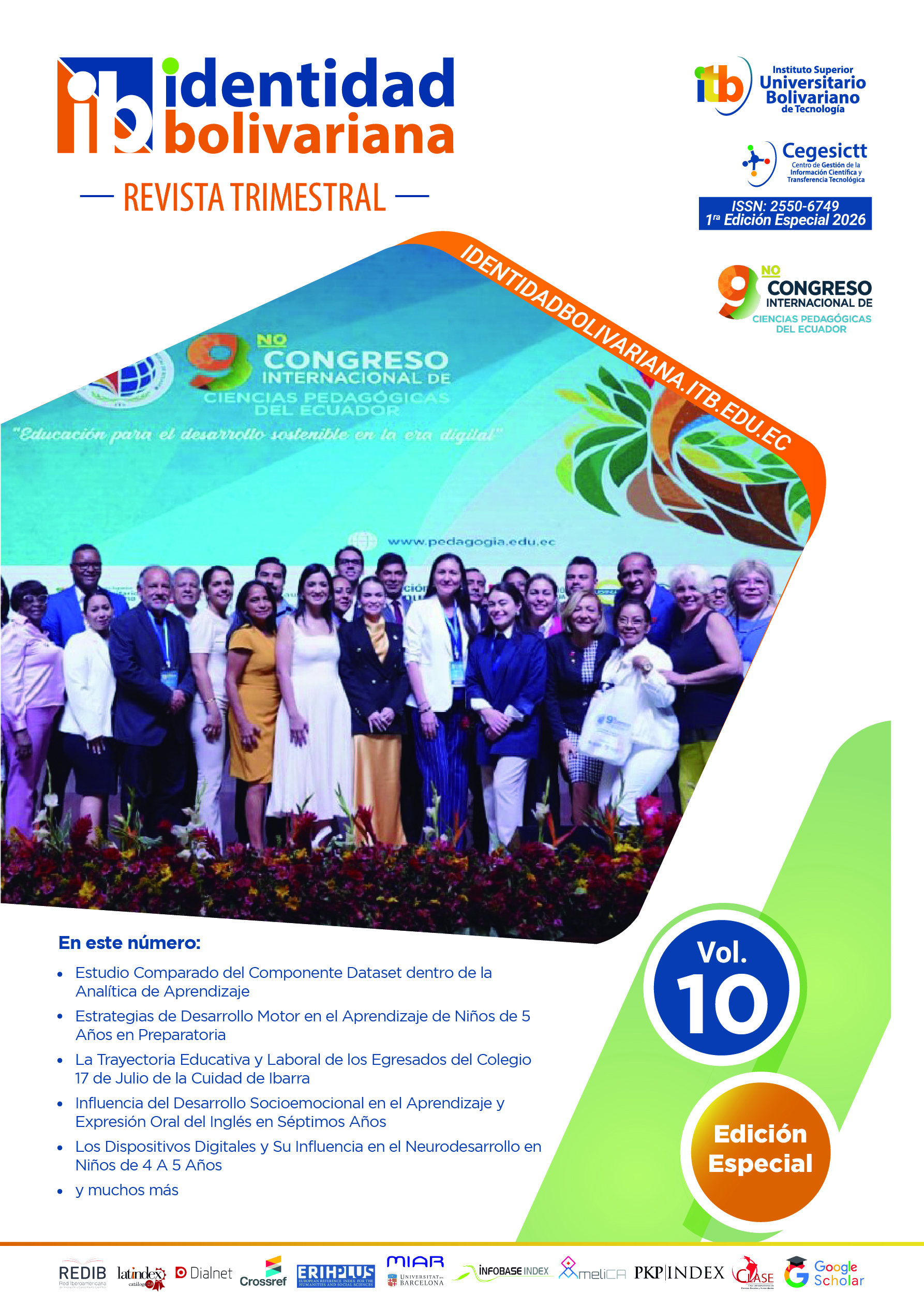
Published 2026-05-19
Keywords
- Reading comprehension,
- inferential reading,
- critical reading,
- digital storytelling,
- educational infographic
- information literacy ...More
How to Cite
Abstract
This article aims to design and validate a didactic proposal based on digital storytelling through the Piktochart tool to strengthen inferential and critical reading comprehension among third-year high school students. The study originated from a diagnostic evaluation conducted at Unidad Educativa Particular Borja, which revealed that students demonstrate adequate literal comprehension but show marked difficulties when making inferences or expressing critical judgments about texts.
The proposal consists of six interrelated phases: initial diagnosis, source curation, guided reading, multimodal narrative production, oral argumentation, and metacognitive reflection. Each phase includes verifiable products and authentic assessment criteria that allow teachers to observe reading as a process of cognitive construction and creative expression.
Methodologically, the research follows a mixed-methods approach, descriptive in nature and with an applied scope. Data collection involved a reading comprehension diagnostic test, semi-structured interviews with Literature teachers, and expert judgment for content validation. Results highlight a significant gap between literal and inferential-critical comprehension levels, supporting the coherence, pertinence, and innovative value of the proposed system. In conclusion, digital storytelling emerges as a feasible and replicable didactic strategy that promotes deep reading, argumentation, and critical knowledge construction among high school students.
Downloads
References
- Association of College & Research Libraries. (2015). Framework for information literacy for higher education. https://www.ala.org/acrl/standards/ilframework
- Bach, B., Keck, M., Rajabiyazdi, F., Kerren, A., Dykes, J., Fisher, D., Kennedy, J., & Nacenta, M. (2023). Challenges and opportunities in data visualization education: A call to action. Computer Graphics Forum, 42(3), 567–583. https://doi.org/10.1111/cgf.14954
- Barrett, T. C. (1972). Taxonomy of reading comprehension. In P. Pimsleur & T. Quinn (Eds.), The psychology of second language learning (pp. 416–423). Cambridge University Press.
- Bhattacharya, A., & Banerjee, P. (2024). The power of visual storytelling: A deep learning approach. International Journal of Intelligent Systems and Applications in Education, 1–12. https://doi.org/10.48059/ijisae.2024.05168
- Biggs, J., & Tang, C. (2011). Teaching for quality learning at university (4th ed.). Open University Press / McGraw-Hill.
- Instituto Nacional de Evaluación Educativa. (2025). Informe nacional Ser Estudiante – Nivel de Bachillerato. Año lectivo 2023–2024. Quito, Ecuador. https://cloud.evaluacion.gob.ec/dagireportes/sestciclo21/nacional/2023-2024_3.pdf
- Jewitt, C. (2008). Multimodality and literacy in school classrooms. Review of Research in Education, 32(1), 241–267. https://doi.org/10.3102/0091732X07310586
- Kintsch, W., & van Dijk, T. A. (1978). Toward a model of text comprehension and production. Psychological Review, 85(5), 363–394. https://doi.org/10.1037/0033-295X.85.5.363
- Kress, G., & van Leeuwen, T. (2001). Multimodal discourse: The modes and media of contemporary communication. Arnold.
- Mayer, R. E. (2020). Multimedia learning (3rd ed.). Cambridge University Press.
- Ministerio de Educación del Ecuador. (2016). Currículo de Lengua y Literatura. https://educacion.gob.ec/wp-content/uploads/downloads/2016/03/LENGUA.pdf
- OECD. (2019). PISA 2018 results (Volume I): What students know and can do. OECD Publishing. https://doi.org/10.1787/5f07c754-en
- OECD. (2023). PISA 2022 results (Volume I): The state of learning and equity in education. OECD Publishing. https://doi.org/10.1787/53f23881-en
- Snow, C. E. (2002). Reading for understanding: Toward a research and development program in reading comprehension. RAND Corporation. https://www.rand.org/pubs/monograph_reports/MR1465.html
- Wineburg, S., & McGrew, S. (2019). Lateral reading and the nature of expertise: Reading less and learning more when evaluating digital information. Teachers College Record, 121(11), 1–40. https://doi.org/10.2139/ssrn.3048994