
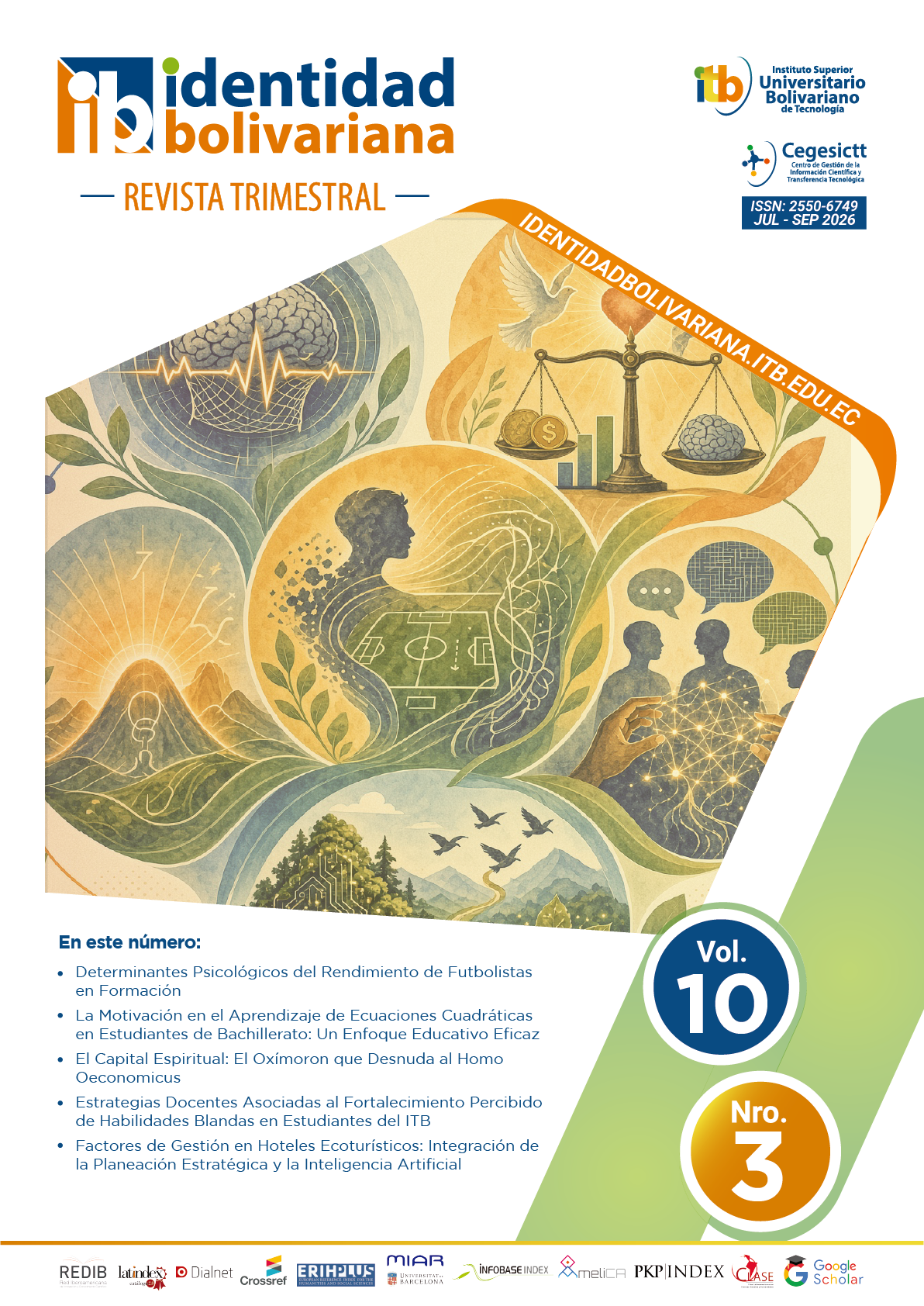
Teaching Strategies Associated with the Perceived Improvement of Soft Skills among ITB Students
 Jheslyn Chinga Ramos
- Jefferson René Ríos Hervas
- Eduardo Espinoza Solis
Published 2026-09-30 — Updated on 2026-09-30
Versions
- 2026-09-30 (2)
- 2026-09-30 (1)
Keywords
- higher education,
- soft skills,
- teaching methods,
- social skills,
- educational assessment
How to Cite
Abstract
Objective: to analyze, by dimension, the association between teaching strategies and the perceived strengthening of soft skills among students at Instituto Superior Universitario Bolivariano de Tecnología, and to examine differences across faculties. Methods: quantitative, non-experimental, cross-sectional, descriptive-correlational study. The initial database contained 142 faculty responses; after removing four duplicate records, 138 complete cases were analyzed. The questionnaire included 30 five-point Likert items organized into two 15-item scales with five dimensions each. Descriptive statistics, Cronbach’s alpha, Spearman correlations, Kruskal-Wallis tests with Holm-adjusted post hoc comparisons, and linear regression with HC3 robust standard errors were used. Results: internal consistency was high for teaching strategies (α = .91) and perceived soft skills (α = .95). The overall association was positive and statistically significant (ρ = .612, p < .001). Feedback and learning climate showed the highest mean among teaching strategies (M = 4.78), whereas communication and argumentation showed the highest mean among perceived soft skills (M = 4.50). Only collaborative learning and communication differed across faculties (H = 7.33, p = .026, ε² = .040). In the multivariable model, collaborative learning and communication (β = .245, p = .029) and autonomy and self-regulation (β = .287, p = .018) were significant. Conclusion: teaching strategies are moderately associated with perceived soft skills, although the cross-sectional design and high-score concentration preclude causal or longitudinal interpretations.
Downloads
References
- Aiken, L. R. (1985). Three coefficients for analyzing the reliability and validity of ratings. Educational and Psychological Measurement, 45(1), 131-142. https://doi.org/10.1177/0013164485451012
- Baker, R., Brick, J. M., Bates, N. A., Battaglia, M., Couper, M. P., Dever, J. A., Gile, K. J., & Tourangeau, R. (2013). Report of the AAPOR task force on non-probability sampling. American Association for Public Opinion Research. https://aapor.org/wp-content/uploads/2022/11/NPS_TF_Report_Final_7_revised_FNL_6_22_13-2.pdf
- Basilico, N., Pedro-Aznar, P., & Peters, M. (2026). Soft skills as durable-adaptive capital: Industry insights for career construction across the lifespan. Higher Education, Skills and Work-Based Learning, 16(8), 33-49. https://doi.org/10.1108/HESWBL-12-2025-0577
- Cronbach, L. J. (1951). Coefficient alpha and the internal structure of tests. Psychometrika, 16, 297-334. https://doi.org/10.1007/BF02310555
- De La Ossa V, J. (2022). Habilidades blandas y ciencia. Revista Colombiana de Ciencia Animal - RECIA, 14(1), e945. https://doi.org/10.24188/recia.v14.n1.2022.945
- Emanuel, F., Ricchiardi, P., Sanseverino, D., & Ghislieri, C. (2021). Make soft skills stronger? An online enhancement platform for higher education. International Journal of Educational Research Open, 2, 100096. https://doi.org/10.1016/j.ijedro.2021.100096
- Escolà-Gascón, Á., & Gallifa, J. (2022). How to measure soft skills in the educational context: Psychometric properties of the SKILLS-in-ONE questionnaire. Studies in Educational Evaluation, 74, 101155. https://doi.org/10.1016/j.stueduc.2022.101155
- Flórez-Espinal, L. (2024). Revisión teórica sobre el concepto de habilidades blandas del emprendedor en relación con la Epistemología del Pensamiento Complejo. 593 Digital Publisher CEIT, 9(5), 443-453. https://doi.org/10.33386/593dp.2024.5.2354
- Jannah, S. M., Putro, N. H. P. S., & Andriyanti, E. (2026). Exploring higher order thinking skills (HOTs) through lecturers’ beliefs and practices in teaching speaking skills. Discover Education, 5(1), 113. https://doi.org/10.1007/s44217-026-01233-2
- Lee, J. Y., Hong, S., & Kim, E. (2026). Soft skills education and training across the nursing continuum: A scoping review. Nurse Education Today, 166, 107287. https://doi.org/10.1016/j.nedt.2026.107287
- López, N., Morales-Asencio, B., Ripoll-Córdoba, D., Coronado-López, J., Caldichoury, N., Quispe-Ayala, C., Salazar, D., Florez, Y., Flores-Poma, I., Castellanos, C., Herrera Pino, J., Quispe-Rodríguez, I., Cárdenas-Valverde, J., Alcos-Flores, K., Muñoz-Romero, E., Cantillo-Pacheco, K., Martínez-Sande, P., Camargo, L., Ocampo-Barba, N., … Gargiulo, P. A. (2025). Internal Validity and Reliability of the GAD-7 Test in Latin America. Chronic Stress, 9, 24705470251315260. https://doi.org/10.1177/24705470251315260
- Mindzak, J., & Mindzak, M. (2026). Robert’s Rules: The accounting classroom as a business meeting. The International Journal of Management Education, 24(3), 101489. https://doi.org/10.1016/j.ijme.2026.101489
- Motschnig, R., Dolezal, D., Švábenský, V., Palubová, K., & Silber, M. (2026). Long-term Effects of Promoting Communication and Soft Skills in Higher Computing Education. ACM Transactions on Computing Education, 26(3), 1-30. https://doi.org/10.1145/3800569
- OECD. (2024). Social and Emotional Skills for Better Lives: Findings from the OECD Survey on Social and Emotional Skills 2023. OECD Publishing. https://doi.org/10.1787/35ca7b7c-en
- Setia, M. S. (2016). Methodology series module 3: Cross-sectional studies. Indian Journal of Dermatology, 61(3), 261–264. https://doi.org/10.4103/0019-5154.182410
- Urkia-Basterra, I., Imaz Agirre, A., & Álvarez-Huerta, P. (2025). Soft skills development in work-based learning: A systematic literature review. Higher Education, Skills and Work-Based Learning. https://doi.org/10.1108/HESWBL-11-2024-0348
- Wang, W., Zhang, Z.-C., Li, Y., Zhang, K., & Du, Y.-M. (2026). Self-supervised fusion of clinical expertise and interpersonal skills for enhanced physician recommendation. Health Information Science and Systems, 14(1), 66. https://doi.org/10.1007/s13755-026-00461-y