
Deficient Diet and its Impact on Sustained Attention in Children Aged 4 to 5 Years

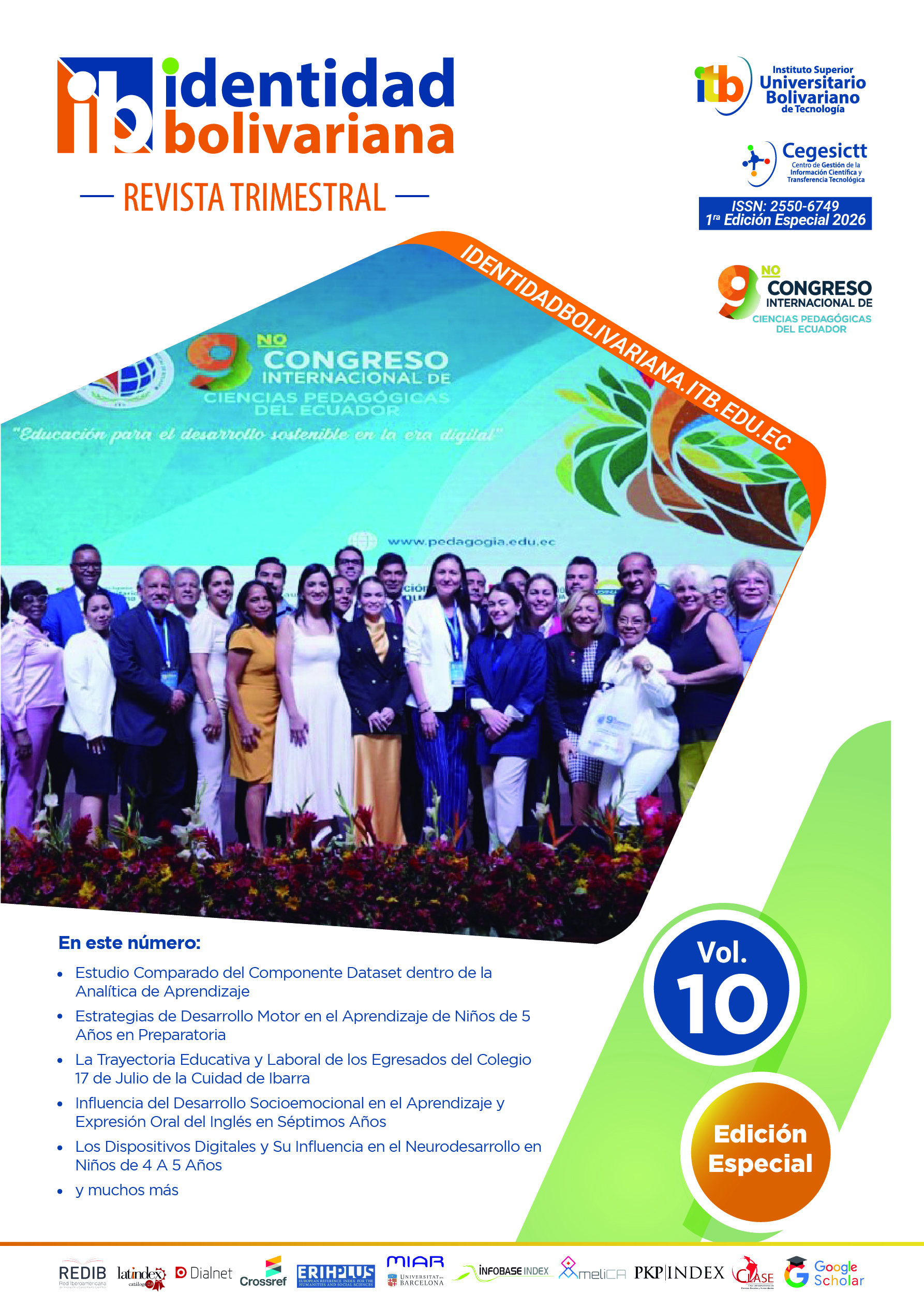
Published 2026-06-24
Keywords
- sustained attention,
- child nutrition,
- executive functions,
- cognitive development,
- early childhood
- educational intervention ...More
How to Cite
Abstract
The study aimed to analyze the influence of deficient nutrition on sustained attention in children aged 4 to 5 years from the “Fray Vicente Solano” Elementary School, located in Pelileo, Tungurahua Province, Ecuador. A mixed-method approach with a quasi-experimental pretest–posttest design was applied, using an observation checklist and teacher interviews. The intervention included playful activities focused on strengthening healthy eating habits. Results showed an increase of over 70% in attention levels, particularly in inhibitory control and refocusing. It is concluded that balanced nutrition and integrated pedagogical strategies contribute to improving cognitive performance in early childhood.
Downloads
References
- Adolphus, K., Lawton, C. L., & Dye, L. (2019). The effects of breakfast on behavior and academic performance in children and adolescents. Frontiers in Human Neuroscience, 13, 1–22. https://doi.org/10.3389/fnhum.2019.00042
- Gutema, B. T., Choukem, S.-P., & Abuye, H. (2023). Association between dietary diversity and cognitive development among preschool children: A systematic review. BMC Pediatrics, 23, 112. https://doi.org/10.1186/s12887-023-03856-4
- Lee, J. S., Park, S., & Kim, H. (2024). Iron deficiency and its impact on cognitive development in early childhood: A review. Nutrients, 16(2), 510. https://doi.org/10.3390/nu16020510
- Lozoff, B., Georgieff, M. K., & Rao, R. (2019). Iron deficiency and brain development. Seminars in Pediatric Neurology, 30, 50–61. https://doi.org/10.1016/j.spen.2019.05.002
- Posner, M. I., Rothbart, M. K., & Voelker, P. (2022). Developing attention and self-regulation in early childhood. Trends in Neuroscience and Education, 28, 100173. https://doi.org/10.1016/j.tine.2022.100173
- Roberts, R. M., Campbell, K., & El-Heis, S. (2022). Nutrition and executive function in early childhood: Systematic review of dietary patterns and cognitive outcomes. Nutrients, 14(11), 2265. https://doi.org/10.3390/nu14112265
- Rojas, M., & Pineda, M. (2021). School-based nutrition and cognitive stimulation programs and their effects on executive functions in early childhood. Journal of Early Childhood Research, 19(4), 456–468. https://doi.org/10.1177/1476718X211012345
- Rueda, M. R., Posner, M. I., & Rothbart, M. K. (2021). The development of executive attention: Contributions to the emergence of self-regulation. Developmental Psychology, 57(12), 2073–2086. https://doi.org/10.1037/dev0001294
- Sarter, M., Givens, B., & Bruno, J. P. (2021). The cognitive neuroscience of sustained attention: Where top-down meets bottom-up. Brain Research Reviews, 137, 66–75. https://doi.org/10.1016/j.brainresrev.2021.03.006
- Stevens, C., & Bavelier, D. (2012). The role of selective attention on academic foundations: A cognitive neuroscience perspective. Developmental Cognitive Neuroscience, 2(1), S30–S48. https://doi.org/10.1016/j.dcn.2011.11.001
- Weigel, M. M., & Armijos, R. X. (2019). Food insecurity and child development in Ecuador: A multi-dimensional analysis. Public Health Nutrition, 22(1), 1–12. https://doi.org/10.1017/S1368980018003018
- Instituto Nacional de Estadística y Censos (INEC). (2024). Situación nutricional infantil en el Ecuador: Informe técnico. https://www.ecuadorencifras.gob.ec
- Organización de las Naciones Unidas para la Agricultura y la Alimentación (FAO). (2024). Panorama de la seguridad alimentaria y nutricional en América Latina y el Caribe. https://www.fao.org