
Strengthening the Pedagogical Training of Technical Teachers: A View from Technical and Technological Education

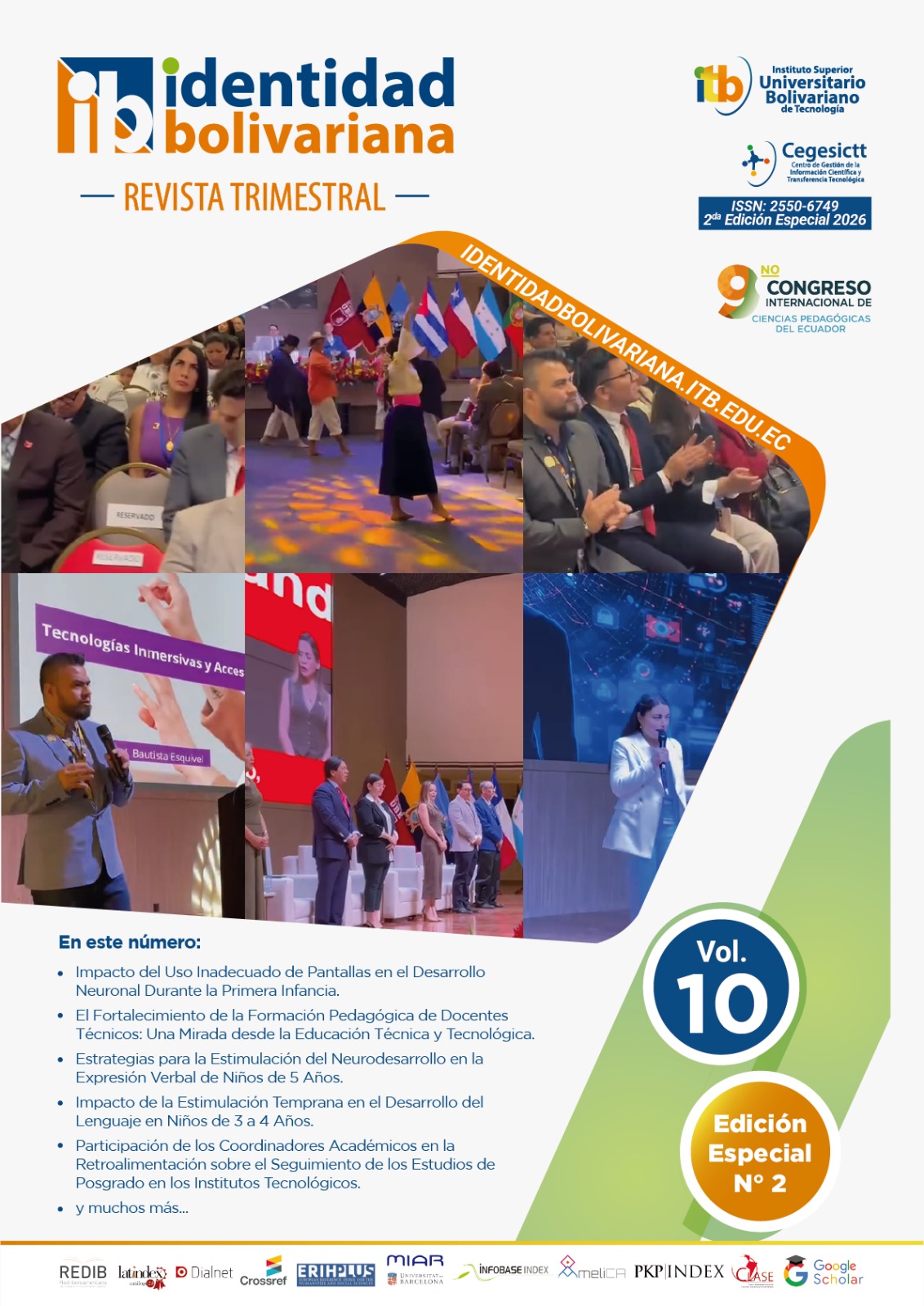
Published 2026-08-27
Keywords
- pedagogical training,
- technical teachers,
- technical education,
- technological education,
- teaching-learning process
How to Cite
Abstract
Technical and technological education plays a strategic role in the training of qualified human capital to meet contemporary productive and social demands. However, one of the main challenges identified at this educational level is the limited pedagogical training of technical teachers, who often have strong disciplinary preparation and professional experience but lack systematic didactic training. This article aims to analyze, through a bibliographic review, the theoretical and empirical foundations related to strengthening the pedagogical training of technical teachers in technical and technological education contexts. The methodology corresponds to a qualitative, documentary, and analytical study based on the review of scientific literature published in recognized academic databases such as Scopus, Redalyc, SciELO, and Google Scholar. The findings indicate that pedagogical training directly impacts the quality of the teaching-learning process, didactic innovation, and the development of professional competencies in students. In addition, training approaches and models that promote the integration of technical knowledge, pedagogical knowledge, and digital competencies are identified. It is concluded that strengthening the pedagogical training of technical teachers is a key factor for improving technical and technological education and ensuring comprehensive, relevant, and contextualized training.
Downloads
References
- American Psychological Association. (2020). Publication manual of the American Psychological Association (7th ed.). APA. https://doi.org/10.1037/0000165-000
- Bisquerra, R. (2014). Metodología de la investigación educativa. La Muralla. https://www.lamuralla.es
- Cué Brugueras, M., Díaz Alonso, G., Díaz Martínez, A. G., & Valdés Abreu, M. (2008). El artículo de revisión. Revista Cubana de Salud Pública, 34(4). Retrieved diciembre 28, 2025, from http://scielo.sld.cu/scielo.php?script=sci_arttext&pid=S0864-34662008000400011&lng=es&tlng=es.
- Darling-Hammond, L. (2017). Teacher education around the world: What can we learn from international practice? European Journal of Teacher Education, 40(3), 291–309. https://doi.org/10.1080/02619768.2017.1315399
- Díaz-Barriga, F. (2013). Enseñanza situada: vínculo entre la escuela y la vida. McGraw-Hill. http://benu.edu.mx/wp-content/uploads/2015/05/ensenanza_situada_vinculo_entre_la_escuela_y_la_vida.pdf
- Fuster-Guillén, D. (2021). Investigación cualitativa: método fenomenológico hermenéutico. Propósitos y Representaciones, 9(1), e792. https://doi.org/10.20511/pyr2019.v7n1.267
- Guirao-Goris, J. A., Olmedo-Salas, A., & Ferrer-Ferrandis, E. (2008). El artículo de revisión. Revista Iberoamericana de Enfermería Comunitaria, 1(1), 1–6. http://revista.enfermeriacomunitaria.org/articuloCompleto.php?ID=7
- Hernández-Sampieri, R., Fernández-Collado, C., & Baptista, P. (2014). Metodología de la investigación (6.ª ed.). McGraw-Hill. https://apiperiodico.jalisco.gob.mx/api/sites/periodicooficial.jalisco.gob.mx/files/metodologia_de_la_investigacion_-_roberto_hernandez_sampieri.pdf
- Imbernón, F. (2017). La formación y el desarrollo profesional del profesorado. Graó. https://doi.org/10.25145/j.qurricul.2020.33.04
- Kitchenham, B., & Charters, S. (2007). Guidelines for performing systematic literature reviews in software engineering. EBSE. https://www.researchgate.net/publication/302924724_Guidelines_for_performing_Systematic_Literature_Reviews_in_Software_Engineering
- Shulman, L. S. (1987). Knowledge and teaching: Foundations of the new reform. Harvard Educational Review, 57(1), 1–22. https://doi.org/10.17763/haer.57.1.j463w79r56455411
- Tobón, S. (2018). Formación basada en competencias: pensamiento complejo, diseño curricular y didáctica. Ecoe Ediciones. https://www.uv.mx/psicologia/files/2015/07/Tobon-S.-Formacion-basada-en-competencias.pdf
- UNESCO. (2016). Strategy for Technical and Vocational Education and Training (TVET) 2016–2021. UNESCO. https://unesdoc.unesco.org/ark:/48223/pf0000245894
- Vaillant, D., & Marcelo, C. (2015). El ABC y D de la formación docente. Narcea. https://ebooks.narceaediciones.es/
- Zabalza, M. A. (2013). Competencias docentes del profesorado universitario. Narcea. https://ebooks.narceaediciones.es/